Keeping your effluent well mixed in an above-ground tank is a little different to your typical pond. While the concept is still the same – you want to keep solids in suspension to maximise nutrient use and reduce strain on your pump – the execution needs to be different.
Tank size, stirrer position, power source, and flow direction all affect how effectively you can circulate the tank’s contents. Here are our top three recommendations for stirring an above-ground effluent tank, plus what we wouldn’t recommend.
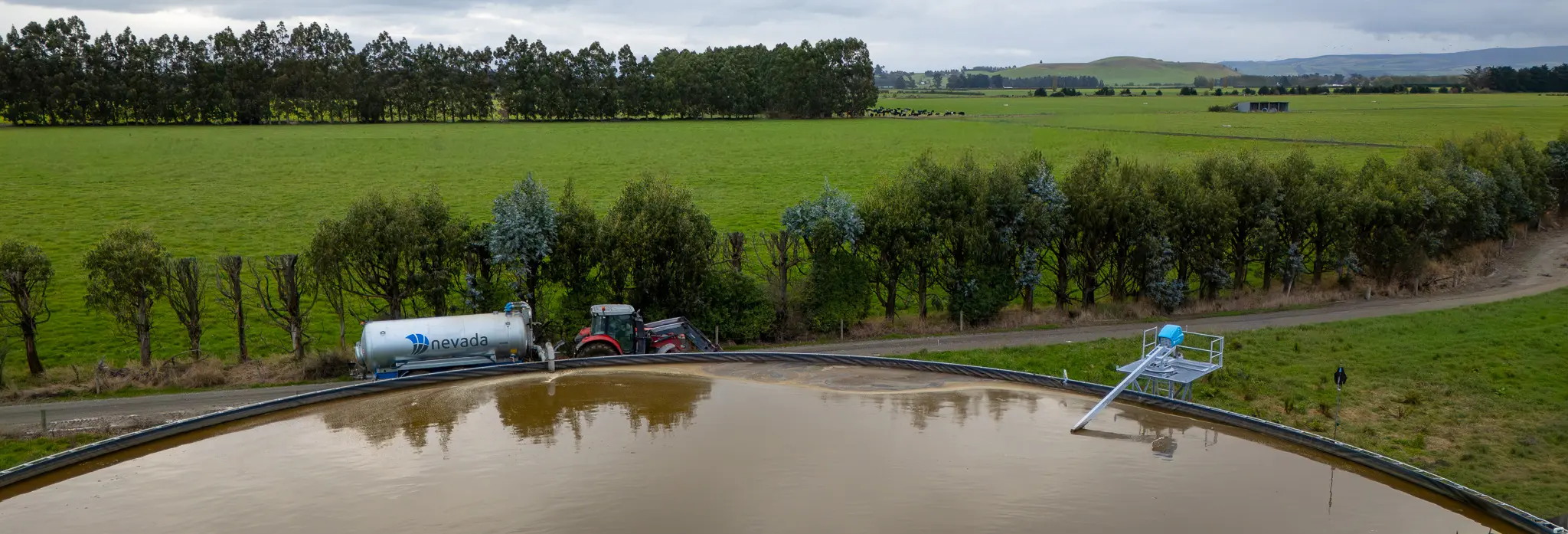
Over-the-wall horizontal stirring is the ultimate option because it is the most effective. The stirrer can be positioned far enough into the tank and angled for optimal flow.
This lets the stirrer break up any crust at the top and bring sediment from the bottom into rotation. The result is better movement throughout the tank rather than concentrating the stirring action in one area.
For best efficiency, go electric where possible. Your running costs will be lower, and the stirrer can be automated, which drastically reduces labour requirements. In most cases, we find farmers with electric stirrers can stir their effluent tanks and ponds more often because it requires very little effort.
There are two main options for an electric over-the-wall slurry stirrer for a tank:
This has been the more traditional method for electric stirring over the wall of an above-ground tank. The electric stirrer is simply mounted on a pedestal, allowing it to reach over the wall and into the tank.


The latest method for over-the-wall electric stirring uses an electric stirrer with an extended mast that reaches over the tank wall. This is more cost-effective than a pedestal and more convenient, as it operates from the ground.
As we’ve said above, for efficiency, go electric where possible. Never underestimate the value of your time and the time of your staff. Once you’ve experienced automation, you’ll never look back!
That said, a submersible or floating vertical effluent stirrer can be your next best option if you only have a small effluent tank.
For above-ground effluent tanks smaller than 300,000L, these will get the job done if you place them far enough from the wall to allow the effluent to circulate properly.
In principle, we prefer to keep electricity out of the water, but submersible stirrers do have the advantage of being relatively easy to retrieve for maintenance.
A floating vertical stirrer can do a good job in small above-ground tanks with diameters of 10 to 12m. This size lets the stirrer circulate the tank effectively and keep solids in suspension.
Neither option will be as efficient as an over-the-wall electric stirrer, but for smaller tanks they can provide a practical alternative.
If you’re a contractor or electricity is not an option, a PTO tractor-driven stirrer with an over-the-wall extension is best.
These are highly effective, and placing them over the wall provides excellent mixing performance by letting the stirrer reach deeper into the tank. The trade-off is that it will tie up your tractor while you get the job done.
For occasional stirring, or when an electric installation simply isn’t practical, a PTO setup remains a solid option.


Two common setups we don’t generally recommend are through-the-wall stirrers and using a pump to stir. Here’s why.
These stirrers can work. However, they are likely to be less effective because they’re situated near the bottom of the tank.
This means they can do a good job of preventing solids from settling at the bottom of the effluent tank, but they’re unlikely to have the ability to draw solids and crust down from the top. That can make it harder to achieve consistent circulation throughout the tank’s full contents.
Of course, through-the-wall also compromises your tank’s integrity, so you’ll want to make sure the installation is built well to reduce the risk of leaks.
While it may seem logical to use your pump to stir, a pump isn’t designed for that, and it is unlikely to be adequate.
Relying on a pump to stir your effluent also adds unnecessary hours and wear to the pump and can cause blockages. A dedicated stirrer creates the movement needed to keep solids suspended before the effluent reaches your pump.
No single setup works for every above-ground effluent tank. Tank diameter and capacity, access, available electricity, how frequently you need to stir and the amount of solids you’re dealing with can all influence the best option.
As a general rule, we favour an electric over-the-wall setup wherever practical because of its mixing performance, low labour requirements, and automation potential. For smaller tanks or sites where electricity isn’t an option, submersible, floating or PTO alternatives can still get the job done when they’re properly matched to the tank.
Not sure which setup will work best for your tank? Give one of our experts a call. We can talk through your tank, effluent system and requirements and help you find the right stirring setup.
"*" indicates required fields
"*" indicates required fields
"*" indicates required fields
"*" indicates required fields